
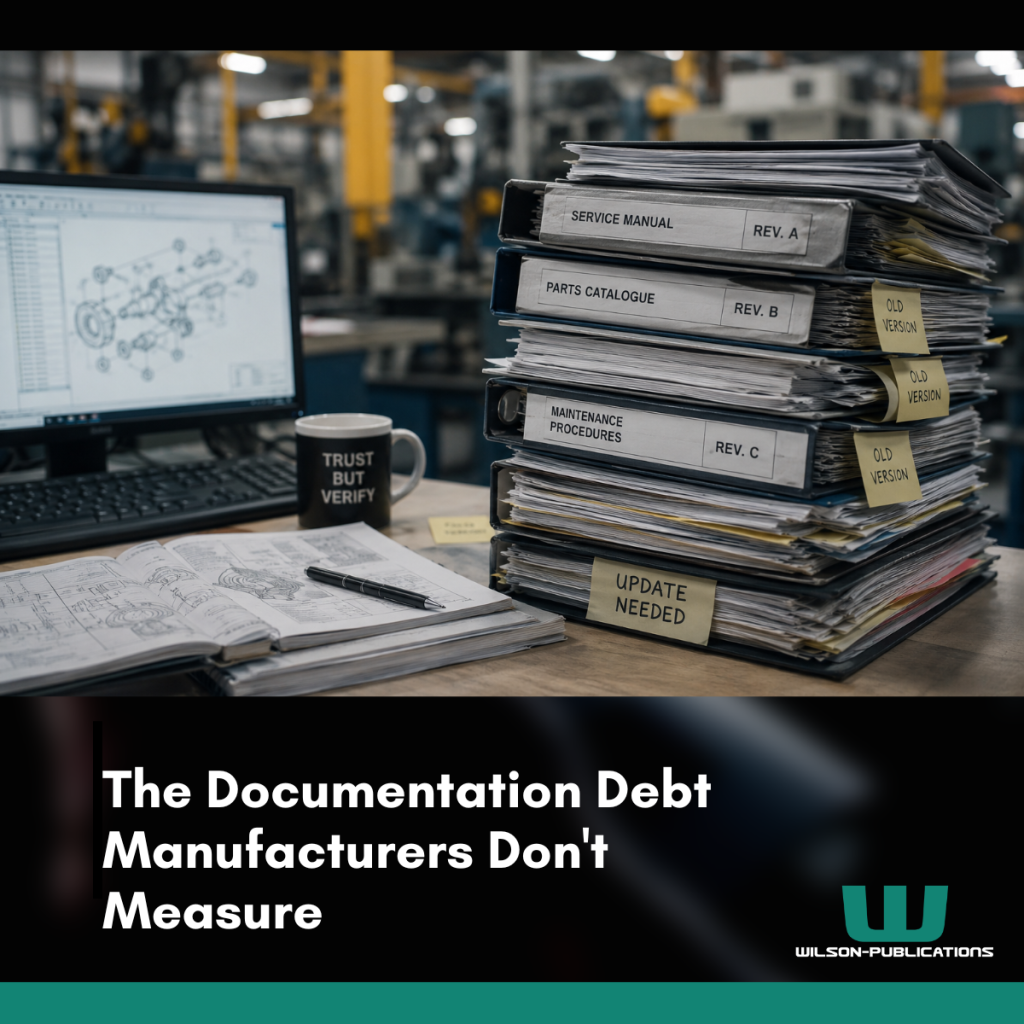
The Documentation Debt Manufacturers Don't Measure
When manufacturers talk about operational efficiency, they often focus on production bottlenecks, equipment reliability, inventory management and maintenance performance.
But there is another form of debt quietly accumulating in many organisations.
Documentation debt.
Unlike financial debt, it rarely appears on a balance sheet.
Unlike technical debt, it is rarely discussed in management meetings.
Yet its impact can be felt across engineering, service, maintenance, training and aftermarket support.
The challenge is that documentation debt often develops gradually. Small compromises made today create larger operational problems tomorrow.
Table of Contents
What Is Documentation Debt?
Documentation debt occurs when technical documentation falls behind the reality of the product, process or operation it is supposed to support.
It can take many forms:
- Outdated maintenance procedures
- Incorrect parts information
- Uncontrolled manual revisions
- Duplicate content across multiple documents
- Missing illustrations or diagrams
- Inconsistent terminology
- Documentation that no longer reflects product changes
Each individual issue may seem minor.
Collectively, they create friction throughout the organisation.
Much like technical debt in software development, the longer documentation debt is ignored, the more expensive it becomes to resolve.
How Documentation Debt Builds Up
Documentation debt rarely appears because of a single major failure.
More often, it develops through a series of small decisions.
A component changes, but the parts manual is not updated.
A maintenance procedure is revised, but older versions remain accessible.
A new product variant is introduced, requiring another manual to be created from an existing document.
Content is copied and pasted instead of managed centrally.
Over time, documentation becomes harder to maintain, harder to trust and increasingly disconnected from the product itself.
The documentation may still appear complete.
The problem is that it is no longer fully reliable.
The Warning Signs
Many manufacturers already have documentation debt but do not recognise it.
Common warning signs include:
- Multiple versions of the same manual
- Frequent requests for clarification
- Documentation updates that are repeatedly delayed
- Product changes that are not reflected in manuals
- Increasing maintenance of documentation itself
- Engineers relying on internal experts rather than official procedures
- Duplicate content appearing across multiple documents
If these issues feel familiar, the documentation may be creating more operational friction than expected.
The Hidden Operational Costs
The true cost of documentation debt is rarely the effort required to update a manual.
The larger cost comes from the operational inefficiencies it creates.
Engineers Spend More Time Searching
When documentation becomes inconsistent, users spend more time confirming information.
Instead of finding an answer quickly, they must:
- Search multiple documents
- Verify revision status
- Compare conflicting information
- Ask colleagues for clarification
The result is lost productivity before work even begins.
Maintenance Activities Take Longer
When procedures are unclear or difficult to trust, technicians often pause to confirm the next step.
This hesitation increases maintenance times and can extend equipment downtime.
Even small delays become significant when multiplied across multiple service activities.
Teams Rely on Tribal Knowledge
One of the clearest signs of documentation debt is when employees stop using the documentation altogether.
Instead, they rely on:
- Personal experience
- Informal workarounds
- Internal conversations
- Memory
This may work while experienced staff remain available.
However, it creates risk when personnel change, teams grow or knowledge leaves the organisation.
Errors Become More Likely
When information is difficult to find or confidence in documentation declines, mistakes become more common.
These mistakes may include:
- Ordering incorrect parts
- Following outdated procedures
- Misidentifying components
- Applying inconsistent maintenance practices
In many cases, the documentation still exists.
The problem is that users no longer trust it enough to rely on it.
Reducing Documentation Debt
The solution is not simply creating more documentation.
The goal is creating documentation that remains accurate, controlled and maintainable over time.
This often requires:
Stronger Version Control
Users should always know which version is current and who owns the document.
Clear revision processes reduce uncertainty and improve confidence.
Regular Review Cycles
Documentation should be reviewed whenever products, processes or components change.
Reviewing documentation only when problems occur allows debt to accumulate.
Improved Structure
Well-structured documentation is easier to update, maintain and scale.
A clear information architecture reduces duplication and improves consistency.
Greater Content Reuse
Structured authoring approaches allow information to be created once and reused across multiple outputs.
This reduces maintenance effort while improving consistency.
Better Visual Communication
Clear diagrams, technical illustrations and visual references help users understand information more quickly and accurately.
Visual clarity reduces ambiguity and supports faster decision-making.
Documentation Is an Operational Asset
Manufacturers routinely invest in machinery, production systems and maintenance programmes to improve performance.
Documentation deserves the same level of attention.
When documentation accurately reflects the product, supports maintenance teams and remains easy to maintain, it becomes a valuable operational asset.
When it is neglected, documentation debt accumulates quietly in the background.
The longer it remains unaddressed, the greater the cost becomes.
The question is not whether documentation debt exists.
The question is how much operational friction it is already creating.
Is Your Documentation Working Against You?
Documentation should support operations, not slow them down.
If outdated content is creating friction across your business, let’s talk.
Frequently Asked Questions:
Documentation debt occurs when manuals, procedures, parts information and technical content no longer accurately reflect the products or processes they support. Over time, this creates inefficiencies, confusion and increased operational risk.
It can lead to longer maintenance times, increased downtime, repeated clarification requests, reliance on tribal knowledge and a greater risk of errors when teams cannot trust the information available.
Common indicators include multiple versions of the same manual, outdated procedures, duplicate content, inconsistent terminology, delayed updates and engineers relying on colleagues rather than official documentation.
When documentation becomes difficult to trust, users often turn to memory, informal workarounds or experienced colleagues instead. This increases risk and makes knowledge transfer more difficult.
Reducing documentation debt typically involves stronger version control, regular review cycles, improved document structure, greater content reuse and clearer visual communication. These measures help keep documentation accurate, maintainable and aligned with operational needs.
Accurate, well-maintained documentation supports faster decision-making, more efficient maintenance, reduced downtime and greater confidence across engineering and support teams. When neglected, it can become a hidden source of operational friction.